Tommy and Miss Lucy
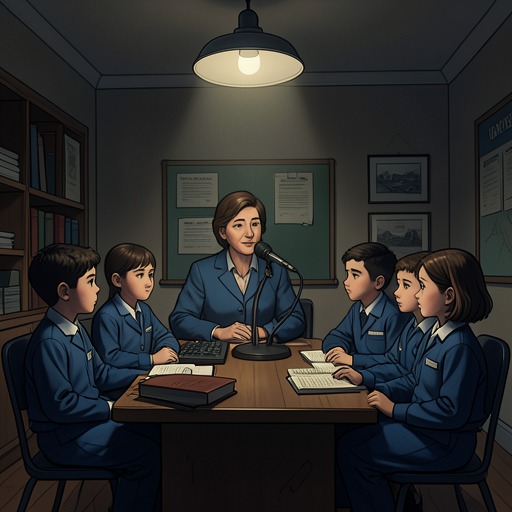
Never Let Me GoTommy and Miss Lucy’s relationship turns on a kindness that cannot remain reassuring. After telling him that his art did not matter, Miss Lucy later admits that she was wrong: she had tried to spare his feelings, but the art mattered both for the students’ own sake and as evidence. Their encounters expose the cost of Hailsham’s guarded truths. Miss Lucy wants to comfort Tommy, yet her changing account leaves him trying to understand a future and a system that neither she nor the other guardians fully explain.
A Reassurance That Fails
Tommy recounts that Miss Lucy asked what he was thinking after she had told him his art was negligible, perhaps even incompetent. She apologized for what she had said before, believing that without her intervention he might have worked the problem out by himself. Tommy tells her that he is all right now: nobody laughs at him about his art anymore, and he can take care of himself when donations begin. His answer shows how he measures his prospects through practical resilience, rather than through artistic promise.
Miss Lucy refuses that consolation. She tells him his art matters, partly because it is evidence, but also for his own sake: he might gain something from making it regardless of its value to others. The distinction complicates her earlier reassurance. She is not simply asking Tommy to become better at art; she is telling him that the work has a significance he has not been allowed to understand, and that significance belongs both to him and to an institution beyond him.
The Gallery and What Cannot Be Said
Tommy asks what Miss Lucy meant by evidence and whether it has something to do with Madame’s gallery. Miss Lucy confirms that Madame’s gallery is important, more so than she had once thought. But she stops short of explaining its purpose. She tells Tommy there are many things he does not understand about Hailsham and his place in the wider world, and that finding out will not be easy. Even students who leave Hailsham, she says, never discover much.
The limits of her explanation matter as much as what she reveals. Miss Lucy recognizes the importance of the gallery and the students’ art, yet she cannot—or does not—lay out the whole system for Tommy. Her regret therefore coexists with continued withholding. She points toward knowledge as something he might pursue, while warning that Hailsham’s students are unlikely to obtain it. The encounter makes her care tangible without making her an uncomplicated source of truth.
Intimacy, Embarrassment, and Lost Time
Miss Lucy’s apology becomes physical as well as verbal. She bends over Tommy and hugs him in the way the guardians used to when the students were little. Tommy remains as still as possible; now that they are older, the gesture embarrasses him, and he is probably bright red. The awkwardness does not cancel the tenderness. Instead, it marks the distance between childhood forms of comfort and the bodily self-consciousness of growing up.
Before leaving, Miss Lucy tells Tommy it is not too late to make up for lost time and asks him to do it for her sake. Tommy says he will try, though by then he mainly wants to get away from the conversation. The request shows how personally she takes her earlier mistake: she is not merely correcting a claim but urging him to act on the importance she had previously denied. Yet the promise is tentative, and the scene offers no assurance that he can recover what he believes he has lost.
Tommy’s Later Understanding
Later, Tommy develops a theory about why Madame collected the students’ work: he believes the gallery helped assess whether couples might qualify for a deferral. In this account, Miss Lucy’s earlier reassurance becomes a consequential error. Tommy says she admitted she had told him art did not matter because she felt sorry for him, even though she knew deep down that it did. Being from Hailsham had given him a special chance, he reasons, and failing to get work into Madame’s gallery was like throwing it away.
Tommy thinks he may have squandered that chance. When Kathy asks whether any of his work ever entered the gallery, he is already shaking his head; he connects his lack of success with his difficulties at art and with Miss Lucy’s reassurance. Kathy cautions that the gallery theory is only a theory and suggests that art might be only one among several ways of judging. The exchange leaves the truth unresolved, but clarifies the relationship’s lasting effect: Miss Lucy’s attempt to protect Tommy becomes part of the explanation he uses to understand his exclusion and his possible future.